




















Help Your Holder!
Like most products, battery holders are designed to often contradictory requirements:
It should be easy to install and remove a battery, but it should be held securely.
Battery holders should be small, lightweight, have a minimal footprint, but should survive drop and vibration tests while holding massive batteries.
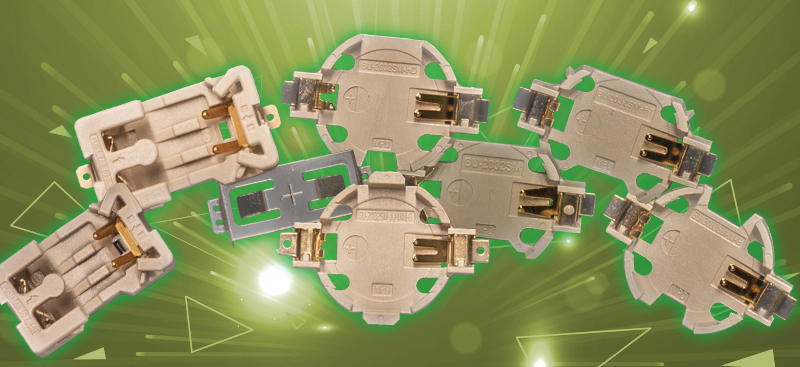
Battery holder designers do their best to meet all of these criteria, but compromises have to be made that place each holder on a performance continuum. One holder may be designed to hold a battery very securely and rely on a tool to remove it, another may have a looser fit with finger notches underneath to make it easy to pry it out, while a third may have a latching mechanism that adds to the size, weight, or cost.
Our product specialists at MPD will be happy to review your requirements and recommend a holder that best fits your needs. But ultimately you, as the product designer, are ultimately responsible for good product design.
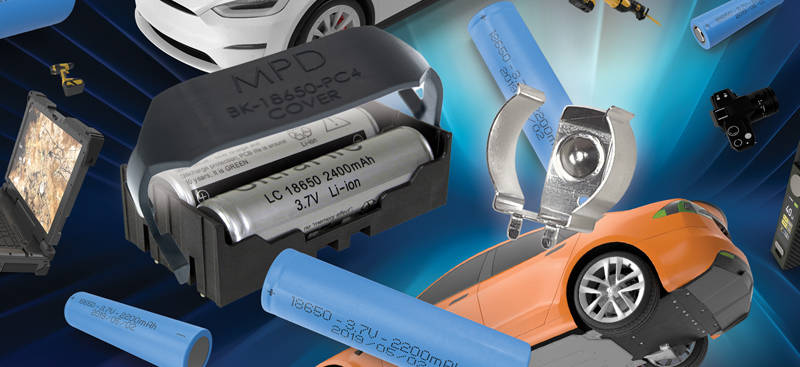
One simple way to make your design more robust is to make the enclosure and the battery holder work together. If you have a battery access door, grow ribs or other features to help hold the batteries securely while it is in place. This allows for the selection of an easy insertion-removal holder, without compromising on battery retention. This can be extremely effective for multiple-battery holders (like 4xAAA or AA holders), where the batteries can have a tendency to buckle if not secure, but if possible support should be added around coin cell holders as well. Adding additional plastic features to existing parts costs next to nothing, but dramatically adds to the robustness of the design.
Depending on the configuration it may be possible to dispense with the holder completely and use MPD's extensive line of loose contacts and springs. When using these components it is important to make sure that the spacing between contacts is appropriate. Keep in mind that most batteries tend to be on the high side of the ANSI tolerance -- by designing your contact spacing between nominal and the upper tolerance limit it will be easier for your customers to insert and remove batteries. See our contact documentation for specific dimensional recommendations.
If it is difficult or impossible for your enclosure to provide additional support to the battery holder, make sure that you select one that is designed for high retention and shock resistance. This is often the case with PCs or similar consumer electronics that have a main circuit board in a metal enclosure. The extra pennies that will be spent on a more robust holder will prevent the much higher expense of customer dissatisfaction, support calls, and product returns.
So, when designing your product, ask not what your battery holder can do for you. Ask what you can do for your battery holder.
Geoffrey Engelstein,
Contact: Sales@MemoryProtectionDevices.com
