













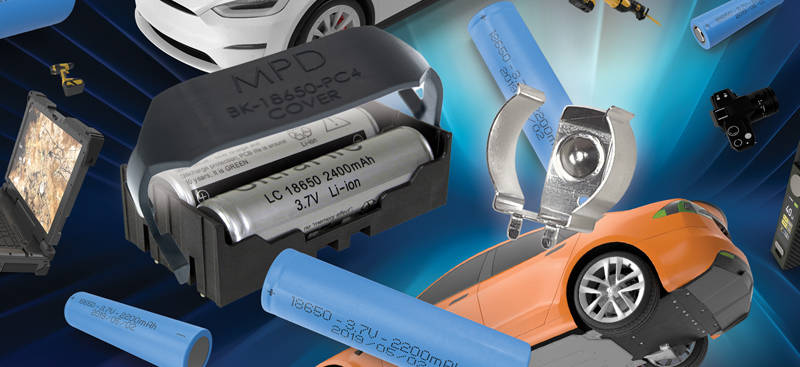




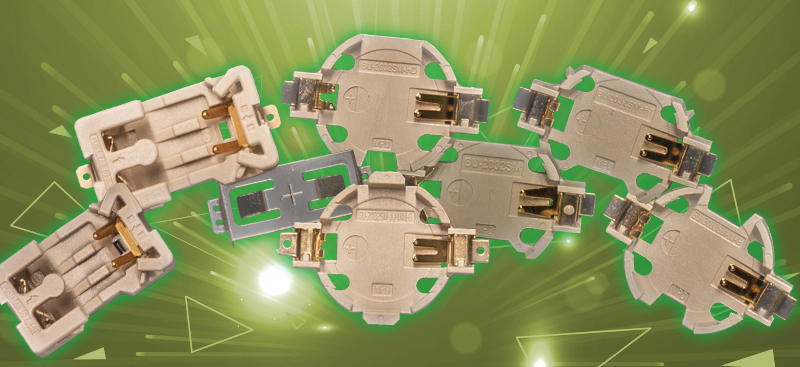


Lithium battery holders by MPD for CR2/3A, CR123A and CR1/2AA cells
have several advantages over competing brands and we invite comparisons:
• Shock and vibration resistance: our battery holders have passed formal shock and vibration testing.
25% thicker contacts: other brands typically have 0.012” thick contacts, versus MPD’s minimum 0.016” contacts. Our BH2/3A is 40% thicker at 0.020” (for industrial applications)
• The contact press’s down on the batteries positive nub aiding retention.
• Stainless steel contacts: we use stainless steel, instead of the spring steel used in most other brands of lithium battery holders for higher corrosion resistance and strength.
• Nickel plated contacts: batteries have nickel plated contacts and the mating area in a battery holder should have the same material to prevent galvanic corrosion between dissimilar metals. See the links below for more information.
The tin alloy plating used by our competitors is for solderability, but since lithium battery holders are hard mounted, the joint is just for making the electrical connection.
• Relying on the holder’s solder joint as the only mechanical attachment is not a good idea because of:
o The weight of the battery combined with impact forces.
o The forces typically applied to the holder or battery during battery exchanges (such as insertion, extraction, prying or torsion).
• Broader temperature ratings: ours are conservatively rated at 180°C. Some other companies’ holders have ratings of only 70ºC (158ºF).
• Contact resistance ratings
• UL file number for the plastic body
• Application notes for selecting the correct eyelet or screw used in hard mounting our battery holders.
Review our drawings, catalog or web pages!
Our engineers just understand battery holders better.
Galvanic corrosion information:
Galvanic and Corrosion Capatability Chart - Engineers Edge
http://www.corrosion-doctors.org/Definitions/galvanic-series.htm

